Knowledge base|Technologie
API Integration: the Connecting Link Between Your Systems
Nowadays, businesses work with dozens of different software systems: from CRM and ERP to payment providers and marketing tools. Without proper integrations, isolated data silos quickly emerge that fail to communicate with each other. In this article, we explain exactly what API integration is, how it works, and why it's essential for efficient, future-proof business software.
What is API Integration?
An API, or Application Programming Interface, is a set of rules and protocols that allows two software systems to communicate with each other. You can think of it as a kind of intermediary: one application sends a request, the API translates this into an understandable instruction for the other system, and then sends the response back.
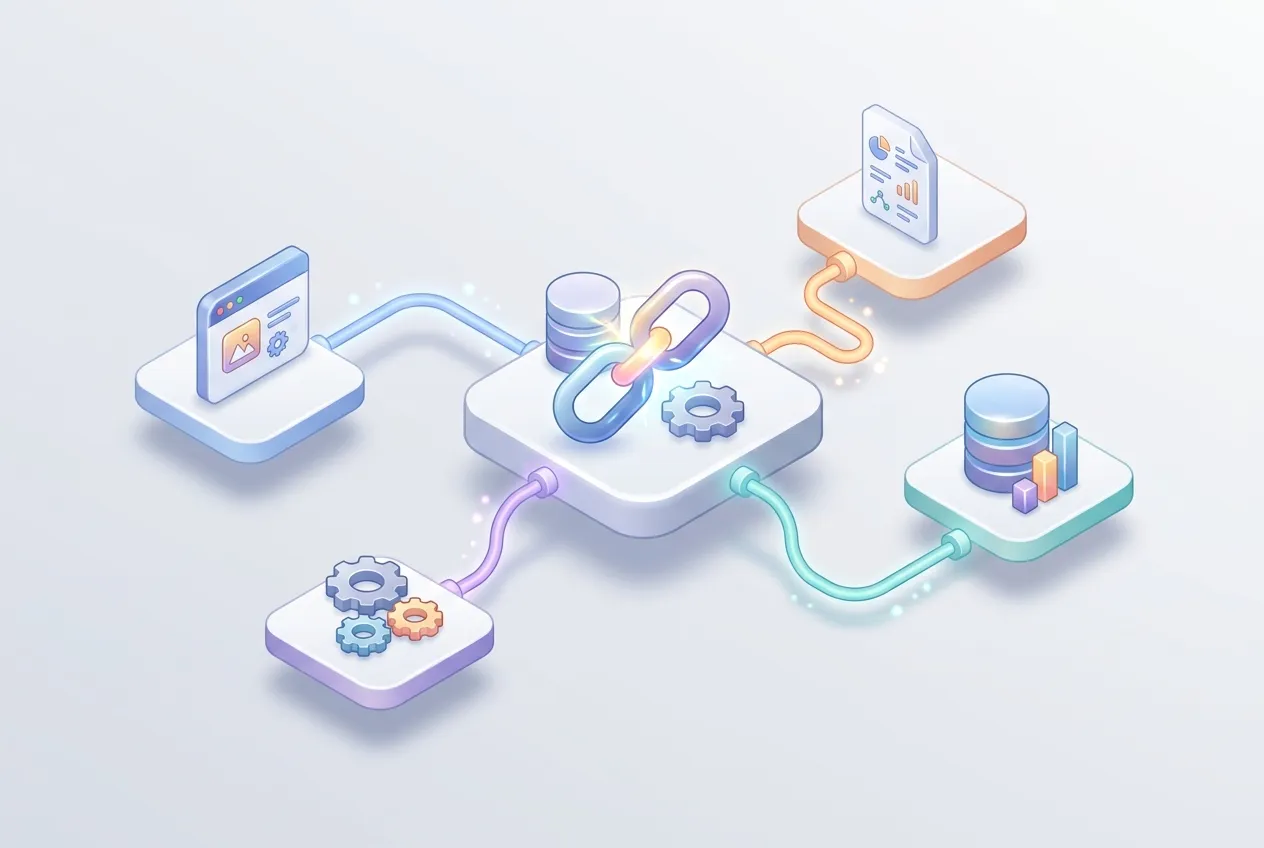
API integration is the process of connecting different software systems through these APIs, so they can automatically exchange data and functionality with each other. Think of a webshop that retrieves real-time inventory data from a warehouse system via an API, or an accounting package that automatically synchronizes invoices with a CRM system.
How Does Connecting Systems via APIs Work?
When connecting systems via an API, one application sends a request to the API of another system. This request usually contains specific instructions, for example: "give me the customer data for customer X" or "register this new order". The receiving API processes this request, retrieves or processes the requested data, and sends a response back, often in a standardized format such as JSON or XML.
There are various types of APIs, with REST and SOAP being the most well-known. REST APIs are currently the most common due to their simplicity and flexibility. Building and maintaining such connections requires solid technical expertise; at Development we ensure systems communicate with each other in a secure and scalable way.
Many APIs also require authentication, for example via an API key or OAuth token, so that only authorized applications gain access to sensitive data. This makes API integration not only functional, but also an important part of a secure IT architecture.
Why is API Integration Crucial for Business Software?
Almost every company uses multiple software packages: a CRM for customer management, an ERP for business processes, marketing tools, payment providers, and sometimes custom software. Without API integration, employees have to manually re-enter data between systems, which is error-prone, time-consuming, and costly.
By integrating business software via APIs, one cohesive whole is created in which data is exchanged automatically and in real time. This delivers concrete benefits:
Efficiency: manual, repetitive tasks disappear, allowing employees to focus on higher-value work.
Data quality: since data no longer needs to be manually re-entered, the chance of errors decreases significantly.
Speed: information is immediately available in all connected systems, instead of only after a manual update.
Scalability: new tools and systems can be added relatively easily to an existing IT architecture without having to rebuild everything.
In short, API connections ensure that business software doesn't function as isolated islands, but as one efficient ecosystem.
Practical Examples of API Connections
API integrations are all around us, even if you don't notice them directly. A webshop, for example, connects with a payment provider such as Mollie or Stripe to process payments, with a shipping partner such as PostNL to display track-and-trace information, and with an accounting package to process invoices automatically.
APIs also play a role in marketing and strategy. Think of automatically forwarding lead data from a contact form to a CRM, or connecting analytics tools to combine the results of keyword research with content and conversion data. These connections allow teams to gain insights faster and make better-informed decisions.
What Should You Consider When Integrating APIs?
Although API integration offers many benefits, it's not simply a matter of connecting two systems together. Several aspects deserve extra attention:
Security: APIs form a gateway to your data, so authentication, encryption, and access management are essential to prevent misuse.
Documentation: a well-documented API makes building and maintaining connections significantly easier and prevents errors.
Error handling: systems must handle situations robustly where an API is temporarily unreachable, so that processes don't get stuck.
Scalability: take future growth into account during design, so the connection continues to function well even as data volume increases.
By properly addressing these aspects from the start, you prevent an API connection from becoming a risk or bottleneck over time instead of an improvement.